
Millions of hours spent daily on unpaid work: evidence from Asia and the Pacific
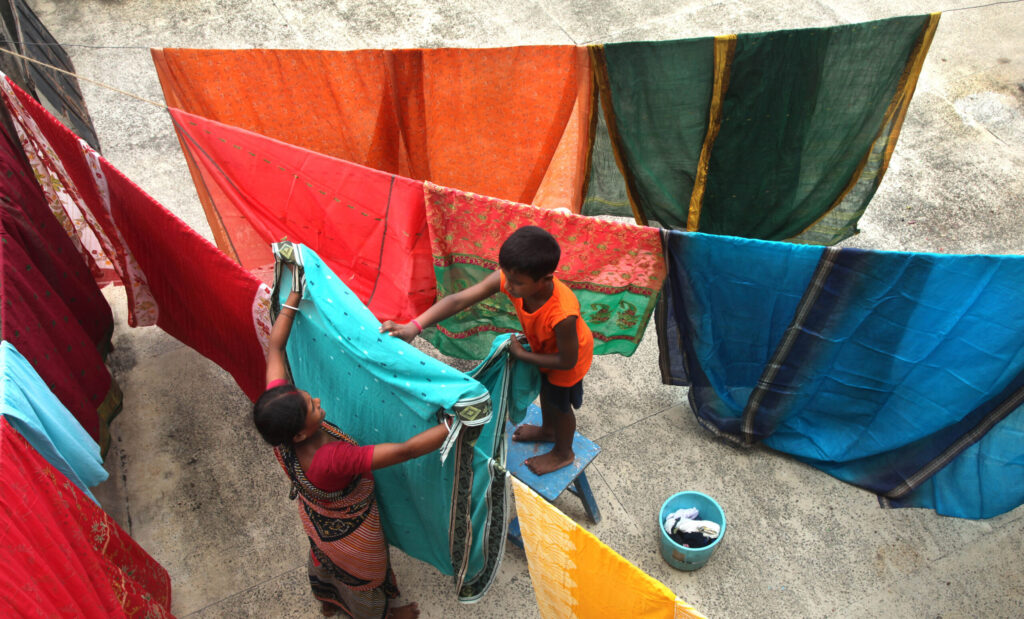
Unpaid production work is the foundation of all other productive work, yet the time spent on these activities is often neglected in labour market analyses.
Capturing impacts on employment and unpaid work using Rapid Surveys

Lack of data on how households and workers are being impacted by the pandemic can severely affect the formulation of programmes and policies aimed to help those most in need. In times of crisis, rapid surveys may be an alternative source of information where official household surveys such as LFS have been halted or postponed. This note provides modules for rapid surveys to shed light on the COVID-19 impacts on paid and unpaid work.
100 statistics on the ILO and the labour market to celebrate the ILO centenary

100 years of the ILO also means 100 years of ILO’s labour statistics to support the work of countries and organizations around the world in improving labour markets, and of course, to inform its own work. Celebrating the ILO centenary is also celebrating progress in labour statistics.
Forms of work: An overview of the new statistical standards

An introduction to the conceptual frameworks for forms of work and labour force statistics, including labour underutilization.
International Classifications of Status in Employment and Status at Work (ICSE and ICSaW)
See the latest international classifications for all forms of work and for employment according to type of authority and economic risk.
Exploring Light Time-Use approaches for measuring productive activities

The ILO has launched efforts to develop guidance to promote accurate measurement of time use in different settings. A particular focus is the development of a data collection strategy centred on the attachment of a Time-Use module to the LFS. The successful design of such an approach offers many potential advantages given the topic overlap between the LFS and TUS, common target populations, high prevalence of LFS internationally, etc. An in-depth review of methods and country practises has been undertaken to inform the design of such a data collection strategy. This review has focussed in most depth on Light Time-Use Diary (LTUD) approaches to assess their suitability. This Brief highlights results, lessons learned and main challenges identified stemming from that review.
Care work and care jobs for the future of decent work

This report takes a comprehensive look at unpaid and paid care work and its relationship with the changing world of work. A key focus is the persistent gender inequalities in households and the labour market, which are inextricably linked with care work.
United Nations Guide to Producing Statistics on Time-Use: Measuring Paid and Unpaid Work
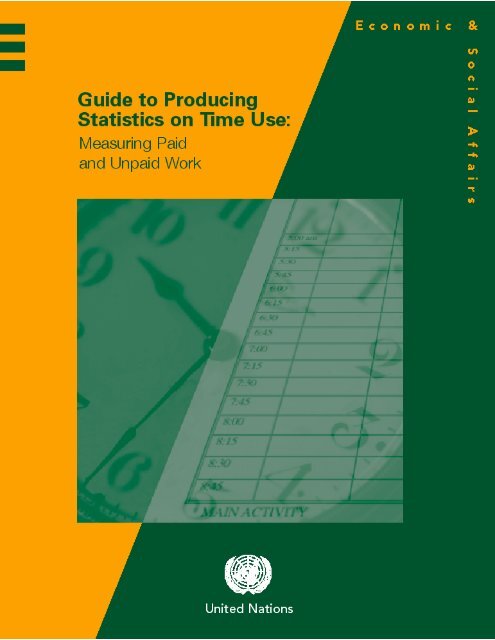
The purpose of the guide is threefold. First, it is conceived as a reference tool for countries interested in conducting time-use surveys. Second, it is aimed at facilitating the harmonization of methods and practices in collecting, processing and disseminating time use statistics. Finally it is meant to solicit comments and suggestions on the trial International Classification of Activities for Time-Use Statistics (ICATUS) which will subsequently be revised and ultimately presented for adoption as an international standard classification.