
ILO model questions on economic characteristics for population censuses

This resource includes model question sequences suitable for inclusion in a census form to capture the UN recommended core and additional topics on economic activity, aligned with the latest standards adopted by the ICLS.
ILOSTAT Home
New global estimates reveal that 2.1 billion people volunteer monthly Latest blog New global estimates reveal that 2.1 billion people volunteer monthly Topics Featured Sustainable development Child labour Unpaid work ILO sectors Labour supply Population and labour force Employment Unemployment and labour underutilization Working conditionsand labour rights Earnings, income and inequality Working time Safety and […]
Labour force survey (LFS) questionnaire toolkit
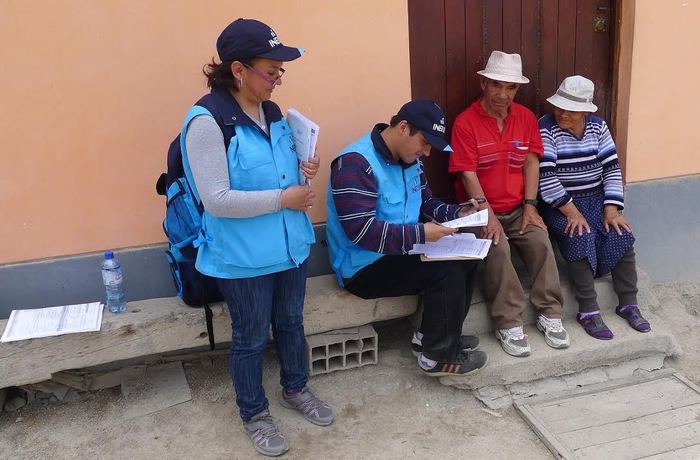
Online resources for data producers to build or improve their labour force survey, such as PAPI and CAPI model questionnaires.
Statistics on the population and labour force

Introduction Statistics on the population and labour force describe the size and composition of the population of working age and those actively engaged in the labour market. ILOSTAT presents data on labour force participation and related indicators used to analyse labour supply across countries. Data catalogue Latest posts Analytical publications Note: Many publications are available […]
What about seniors?

Learn about the situation of older persons in the labour market in What about seniors?, the first issue of our new series Spotlight on work statistics where we use ILOSTAT data to explore various labour market issues.
Key Labor Market Indicators: Analysis with Household Survey Data

This publication is an introduction to labour market indicator analysis and a guide for analysing household survey data using the ADePT ILO Labour Market Indicators Module. The ADePT module is a powerful tool for producing and analysing KILM indicators using household survey data. The software allows researchers and practitioners to automate data production, to minimize data production errors and to quickly produce a wide range of labour market data from labour force surveys or other household surveys that contain labour market information.
Decent Work Indicators – Guidelines for producers and users of statistical and legal framework indicators
This manual presents guidelines on the decent work statistical indicators and legal framework indicators. It is divided into eleven chapters which correspond to the ten substantive elements of decent work as well as to the economic and social context for decent work.
Measuring the Economically Active in Population Censuses: A Handbook

The Handbook (2010) provides guidance on the measurement of economic characteristics in population censuses, based on relevant experiences of countries, with a particular focus on the questions used and the requirements for processing of responses. The Handbook is intended to provide census planners with a variety of approaches to assess the questions and methods of collecting economic characteristics used in their national census, as they evaluate the performance in the past decade and plan for the 2010 round of censuses (2005-2014).
Sources and Methods Volume 3B: Labour force surveys (2011) – Source of statistics of the labour force and its components
This volume presents national methodological descriptions of statistics of employment, unemployment, underemployment, hours of work and other indicators derived from labour force and household surveys, disseminated on ILOSTAT. It is a revised and updated version of the third edition issued in 2004, and contains descriptions for 160 countries and territories and 169 surveys.
Sources and Methods Volume 5: Population censuses (2004) – Total and economically active population, employment and unemployment
This volume is an updated version of the second edition issued in 1996 which presented national methodological descriptions of population censuses carried out during the period 1989-94 in 115 countries, areas and territories. The first edition issued in 1990 covered the period 1945-89.