
UN Handbooks on household surveys
Labour Market Statistics and Analysis Academy

23 November–4 December 2026
Turin, Italy
The main objective of the Academy is to better equip and situate national and international stakeholders in the new SDG statistical monitoring system in the context of the main outcomes of the 20th and 21st ICLS recommendations.
STATA for Labour Market Analysis

Online (E-Campus) 1–26 June and 2026 Turin, Italy 6–10 July 2026
Blended
The main objective of the course is to provide participants with the necessary advanced skills to use the computer software STATA to analyze the labour market for evidence-based policymaking, including SDG and decent work indicators.
Weighting methods & strategies

11 May–19 June 2026
Online (ITC E-Campus)
The main objective of the course is to “enhance understanding and capacities of ILO constituents and social partners to design household surveys and to process sample data in line with best methodological practices.
The role of communication and dissemination in fulfilling the potential of gender-relevant work statistics
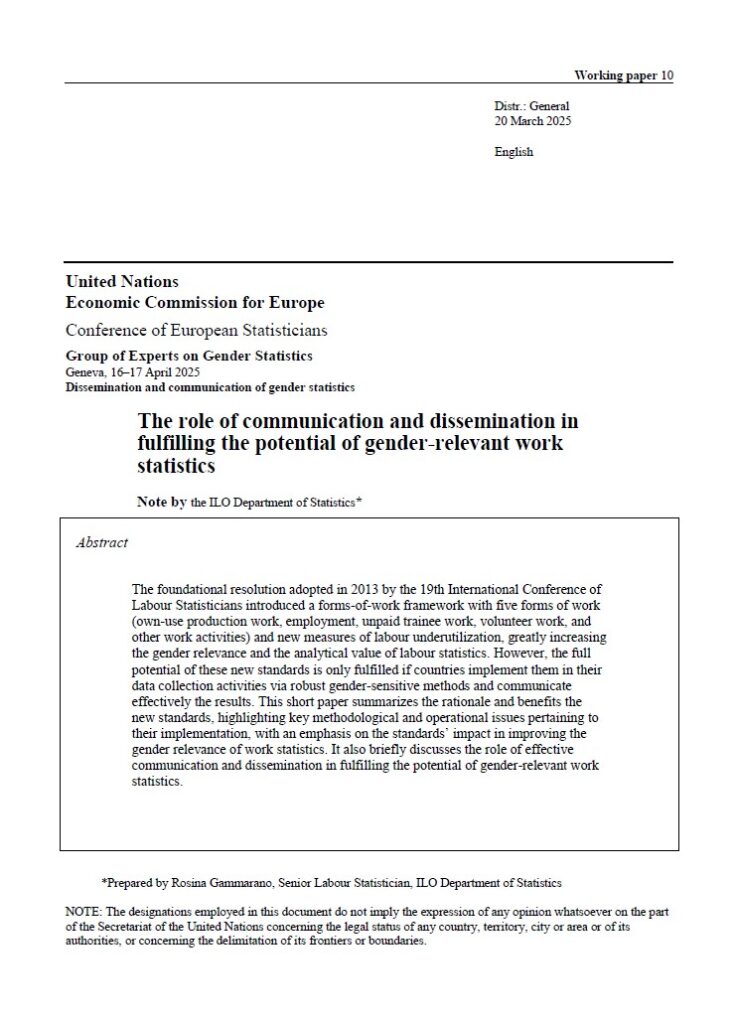
The foundational resolution adopted in 2013 by the 19th International Conference of Labour Statisticians introduced a forms-of-work framework with five forms of work (own-use production work, employment, unpaid trainee work, volunteer work, and other work activities) and new measures of labour underutilization, greatly increasing the gender relevance and the analytical value of labour statistics. However, the full potential of these new standards is only fulfilled if countries implement them in their data collection activities via robust gender-sensitive methods and communicate effectively the results. This short paper summarizes the rationale and benefits the new standards, highlighting key methodological and operational issues pertaining to their implementation, with an emphasis on the standards’ impact in improving the gender relevance of work statistics. It also briefly discusses the role of effective communication and dissemination in fulfilling the potential of gender-relevant work statistics.
Checklist for 19th ICLS standards application

This checklist provides a simple way of verifying that all conditions required to consider the standards adopted by the 19th International Conference of Labour Statisticians (ICLS) as fully applied in a given data collection activity are met.
Quick guide on the communication of results after implementation of latest standards on statistics of work, employment, and labour underutilization
A crucial aspect of the implementation of latest labour statistics standards is the effective communication of the results, to ensure getting the best out of the data. This guide aims to provide practical data visualization examples to convey clearly and intuitively the impact of methodological changes on key labour indicators following the implementation of the 19th ICLS resolution and avoid misinterpretation of the results.
Survey Questions for Collecting Data on Work Relationships and Informality
This document provides recommended survey questions for collecting data on work relationships (ICSE-18), informal employment, and the classification of economic units across three sectors: informal, formal, and household own-use production and community sector. (HOC). It incorporates the 20th ICLS resolution on work relationships (ICSE-18) and the 21st ICLS resolution on statistics for the informal economy.
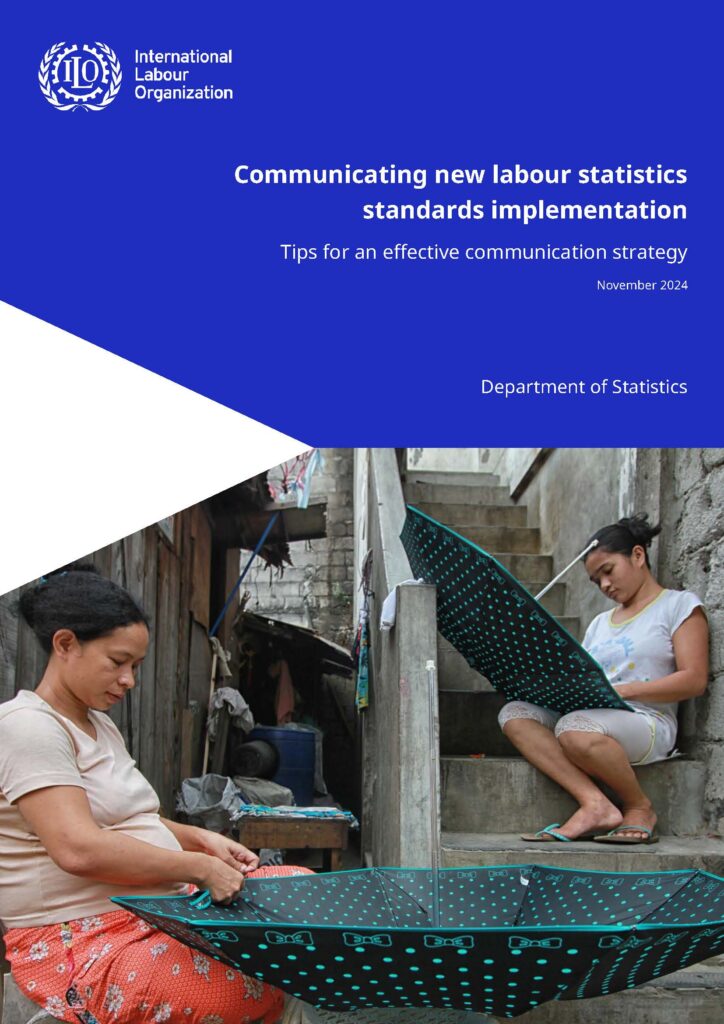
Communicating new labour statistics standards implementation
ILO Labour Force Survey toolkit
Labour force surveys (LFS) are the main source for many key indicators of the labour market and the world of work. To support countries in conducting their national LFS in line with international standards, the ILO Department of Statistics developed an LFS toolkit which features a model survey questionnaire, a national adaptation guide, a variable derivation guide, a syntax sample, and many more resources. Discover the ILO LFS toolkit with this video, and check its contents in its page: https://ilostat.ilo.org/resources/lfs.