
New global estimates reveal that 2.1 billion people volunteer monthly
The latest global estimates challenge the idea that volunteering only happens through organisations and demonstrates the impact of everyday, informal, and unpaid civic action worldwide.
Everyday helpers: What new data reveal about trends in direct volunteering
Information from eight countries reveals direct, person-to-person help to be the world’s most common—and least visible—form of volunteering.
Casting a light on dependent contractors: a new statistical and increasingly important category

While dependent contractors have long existed as a group of workers, they have only been made visible in official statistics recently.
Subsistence foodstuff producers: the importance of making their work visible

On World Food Safety Day, the ILO analyzes the work of subsistence foodstuff producers, as per improved international statistical standards.
Survey Questions for Collecting Data on Work Relationships and Informality
This document provides recommended survey questions for collecting data on work relationships (ICSE-18), informal employment, and the classification of economic units across three sectors: informal, formal, and household own-use production and community sector. (HOC). It incorporates the 20th ICLS resolution on work relationships (ICSE-18) and the 21st ICLS resolution on statistics for the informal economy.
The impact of care responsibilities on women’s labour force participation

This brief provides a detailed overview and analysis of the new ILO global and regional estimates of persons outside the labour force due to care responsibilities.
Shedding Light on the World of Unpaid Domestic and Care Work
Every day, 16 billion hours are devoted to unpaid domestic and care work (UDCW) around the world. As global populations age, these figures are set to rise, with a disproportionate impact on women, who perform the vast majority of this work. Quantifying UDCW is critical to understanding labour markets, employment trends, and gendered roles and inequalities.
To meet this growing need, the Statistical Standards and Methods Unit of ILO has developed a “light time-use measurement module,” an innovative tool building on the latest international best practice that offers more efficient and comprehensive data collection of UDCW, helping us move a step closer to a more equitable world of work and social justice for all.
International Labour Statistics Standards to Cast Light on the World of Work
International labour statistics standards provide a solid common framework to measure the world of work and reveal decent work deficits, enabling governments to shape responsive policies. However, to be effective, these standards must be implemented in data collections. The ILO equips statisticians with practical tools, evidence-based methodologies, and technical guidance to implement new standards and make the most of the data.
The LFS light time-use module
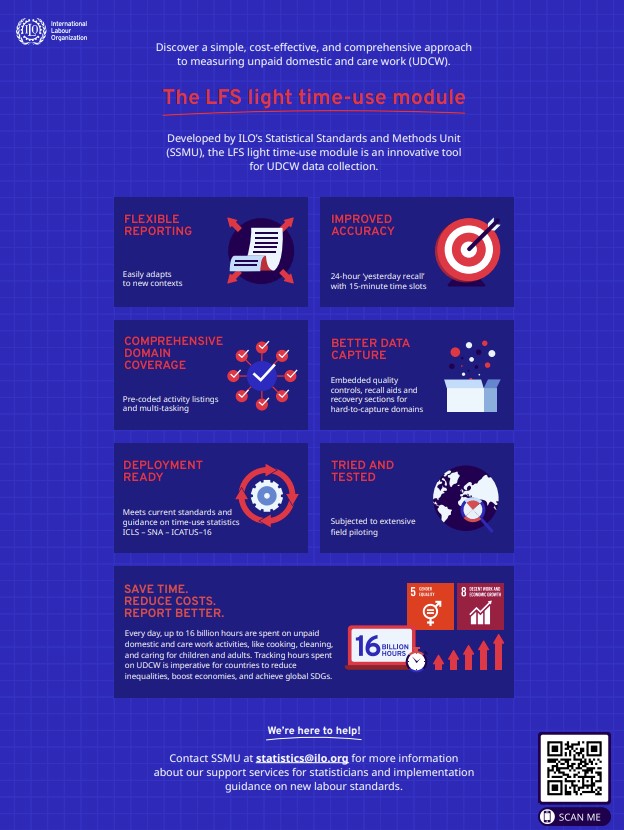
This infographic summarizes the key features of the Labour Force Survey light time-use module, an innovative tool developed by the ILO to measure unpaid domestic and care work with a cost-effective and comprehensive approach.
Unpaid Domestic and Care Work: The Gender Bias
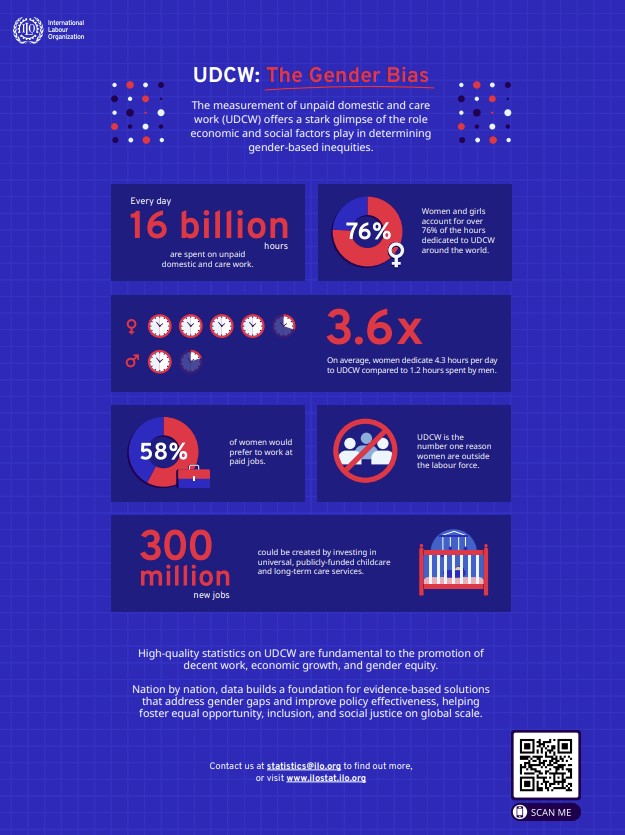
This infographic showcases some key global statistics on unpaid domestic and care work.