The ILO regularly produces internationally comparable estimates of the stock of International Migrants in the Labour Force to provide a global and regional view of the scale and patterns of international labour migration. These estimates help raise awareness about the economic contributions of international migrants and the challenges they may face on the labour market. To support country monitoring of the Global Compact for Safe, Orderly and Regular Migration (GCM), from 2026 the ILO is also releasing country level modelled estimates. The country-level modelled estimates help address the persistent gaps in national data on international labour migration and support international comparison.
The indicator framework for the Global Compact for Safe, Orderly and Regular Migration (GCM) integrates the ILO’s estimates on the total number and proportion of international migrants in the labour force as reference background indicators to support countries in monitoring progress towards its implementation.
The latest edition of the estimates, released in 2024 and based on a new and robust model-based methodology, is now available for download here:
-
Labour force by international migrant statusLabour force by international migrant status
-
Employment by international migrant statusEmployment by international migrant status
-
Unemployment by international migrant statusUnemployment by international migrant status
Learn more

Estimation methodology – ILO Modelled Estimates of International Migrants in the Labour Force
This note presents an overview of the technical foundations of the estimation methodology. It describes the models used, outlines the sources of input data and summarizes the approaches applied to assess the quality of the estimates. Where available, data based on foreign-born population as international migrants were used as input in the models.

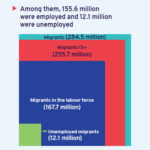
ILO global estimates on international migrants in the labour force: Figures at a glance
See the headline results from the latest edition of the ILO modelled estimates for a quick overview of global and regional findings.